
Messages Thesis.
Keys of Influence.
1 - Difference between Marketing and Propaganda… and Awareness Funnel.
Before even starting, it’s important that I talk about awareness stages.
This is the main key to understanding the Propaganda systems we build.
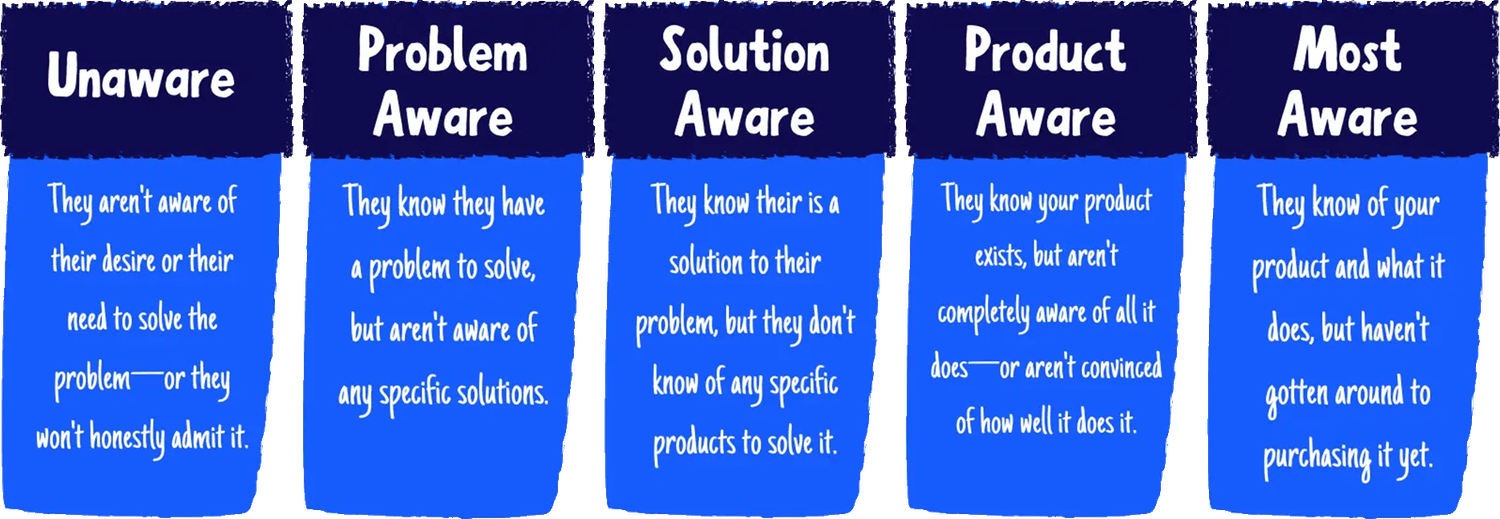
So basically, there are 5 awareness stages.
Here is the most well-known chart that explains this. It comes from Eugene Schwartz, the man who created this concept and wrote Breakthrough Advertising:
You need to see it as a funnel.
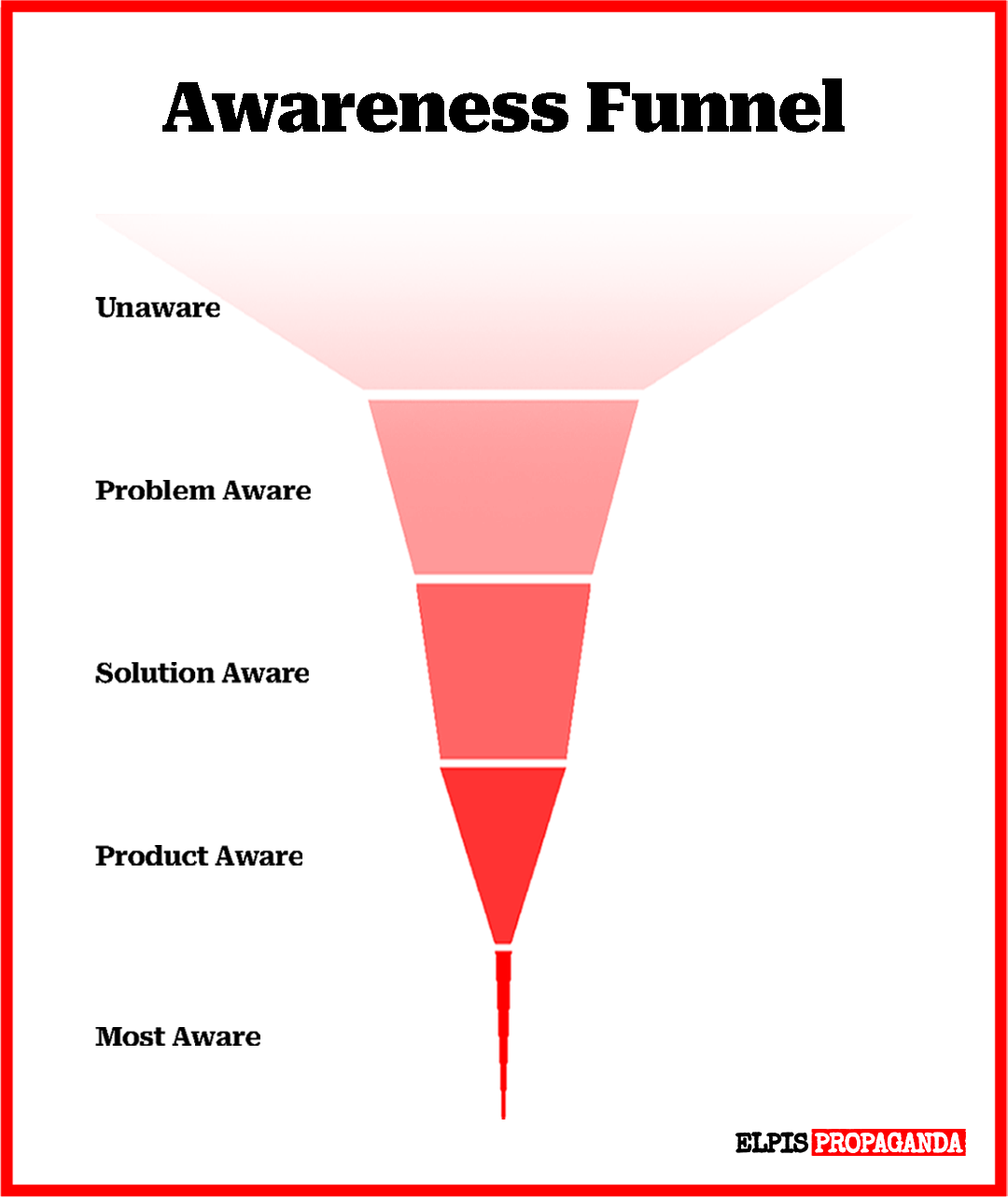
The Unaware represent more or less the entire world (depending on what you sell, of course), while the Most Aware are people who are just waiting for the offer to buy your solution.
I’ll go into more detail with examples just after…
Here is the key:
Most companies do Marketing.
They target:
people who know they have a problem,
people who already know the solutions,
people who have discovered their product,
and people who are waiting for an offer.
And it makes sense:
Identify a pain point → solve it → sell the solution.
But they are not influencing people.
They never target unaware people, even though they represent the majority of their potential market.
And most importantly, by not addressing “unaware” people, you deprive yourself of the best possible relationship:
When you make someone aware of a problem, of a deep desire they had not yet realized… they naturally consider you to be the most legitimate person to provide them with the best solution.
You probably remember the first person who made you want to get into business, and you are most likely still grateful to them.
That first emotion is magical.
It is a very powerful long-term leverage.
That’s what we work on:
Making you become that person for your customers.
It means no longer selling only a mechanism, a solution, or an offer…
It means starting to influence people, creating your own market.
It means playing the Propaganda Game.
Obviously, the measurable consequences are endless:
lower CPMs because we target broader audiences,
better conversions because we guide people through every stage of awareness,
better overall ROI,
and higher LTV because recognition and trust are stronger.
Two Propaganda Stories from Edward Bernays.
One hundred years ago, the man who wrote the book Propaganda transformed eggs and bacon into a “healthy breakfast,” even though no one wanted to eat them in the morning.
He took a completely unaware population, invented a need (“eggs and bacon for breakfast = better health”), and then presented his product as the only logical answer.
By controlling the narrative, he created a belief…
then a tradition…
then an entirely new market.
If you’re wondering whether this could work for your products…
Don’t forget that, at one point in history, cigarettes were sold to women by telling them they were the torch of their freedom.
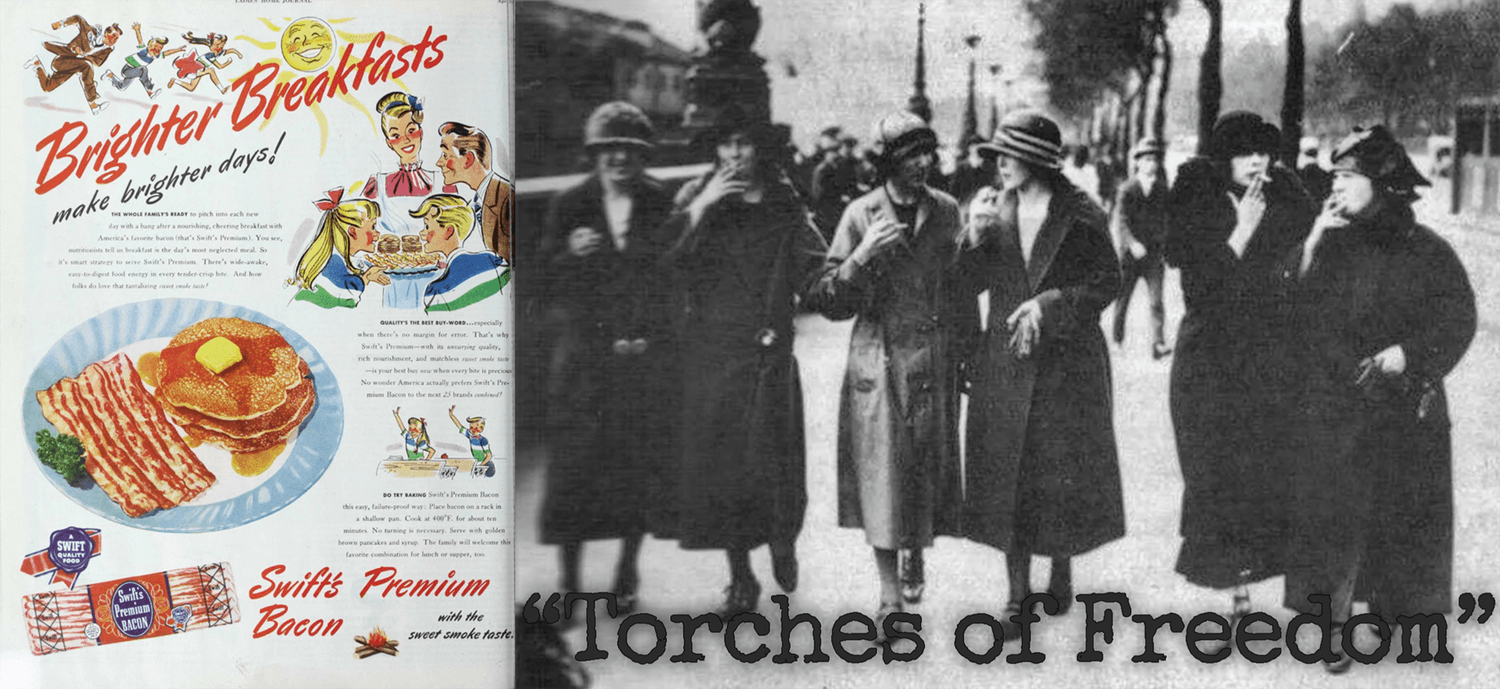
And what you sell can follow the same Propaganda standards and lead to the same results.
The leverage effect, when you master this, cannot be measured in ×10, ×100, or ×1000…
Because when you control the story, you literally create your own market.
You can turn your product into a tradition.
If you have a personal brand, you can turn yourself into an icon, a substitute father figure… whatever fits.
This is Influence… this is the power of Propaganda.
It is the action exerted on people’s opinions to lead them to adopt and support certain ideas.
To sell them a product, a brand, an idea, a personal brand.
You have to play this game if you want to reach the highest level.
Of course, you don’t have to sell death to people.
By the way, I personally prefer to sell life.
But you need to understand this:
You can influence people to do a lot of things if you propagate the right message, at the right time, in the right place.
If you limit yourself to Marketing, achieving this kind of result is impossible.
That doesn’t mean you should stop selling to bottom-of-funnel prospects…
In fact, you must target all awareness stages to make sure you reach your prospect regardless of the stage they are in.
This is where the concept of the Big Idea comes in, adding a new dimension on top of it.
2 - Big Ideas and the Massive Iteration Thesis.
We could define the Big Idea as a bold, unique, credible, and emotionally charged central promise that instantly captures the attention of a specific market and shapes the entire marketing message around it.
In other words, the Big Idea is the core message of your offer — the identity of what you sell.
Most businesses focus on one Big Idea…
1 Product = 1 Big Idea = 1 to 3 Audiences
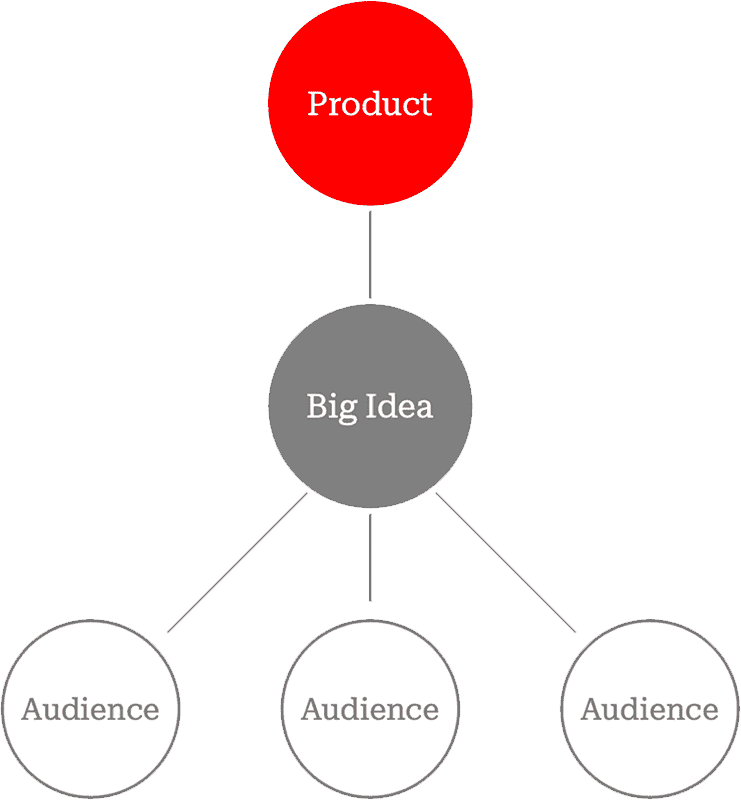
We’ve already seen that you should target audiences across multiple awareness stages.
But you can also have multiple Big Ideas for a single offer.
1 Product = ∞ Big Ideas = All the markets / Sub-Niche your product can reach or create.
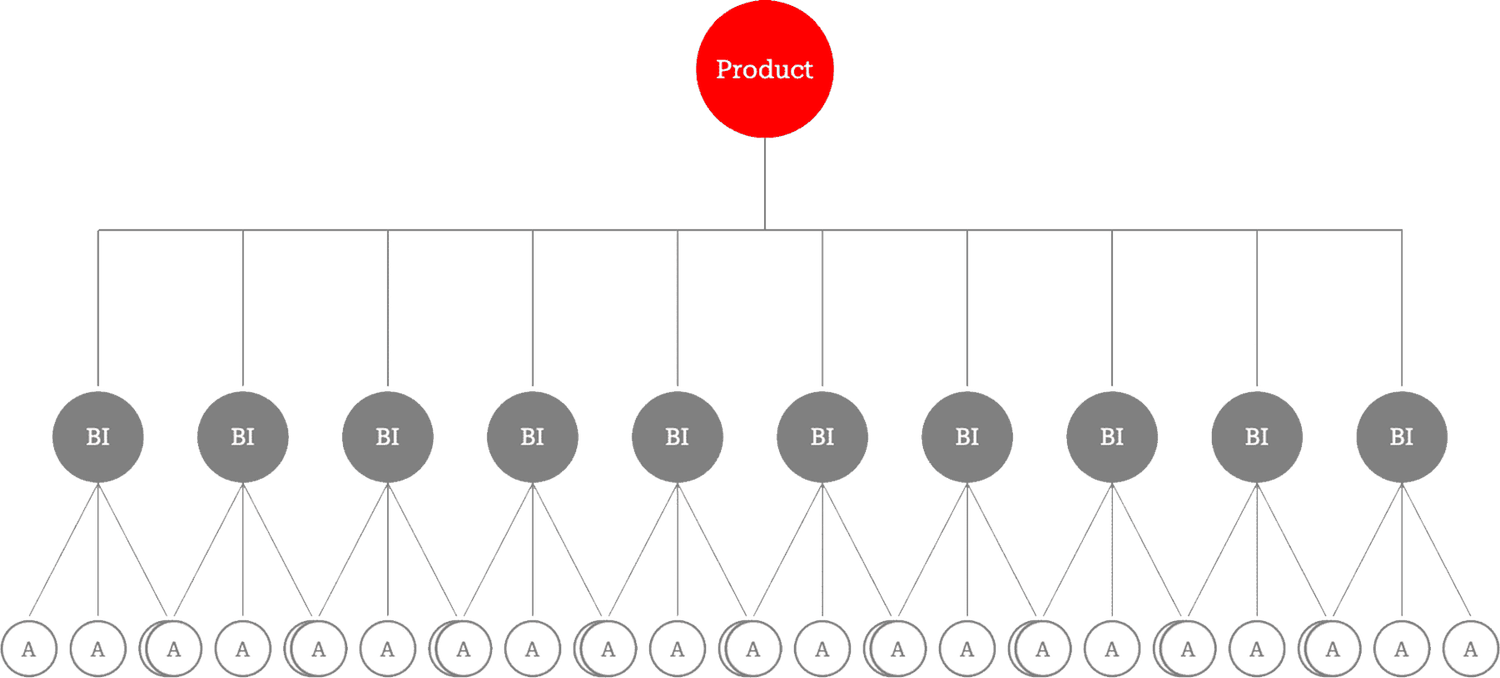
Because for every product, there exists an infinity of possible Big Ideas.
And you need to understand this:
A person can be unaware of one problem your offer solves, and at the same time aware of a solution to another problem your offer also solves.
Depending on the Big Idea, that person is not at the same awareness stage.
Big Idea 1
Unaware
Big Idea 2
Product Aware
Big Idea 3
Problem Aware
By clearly separating these concepts and discovering new Big Ideas:
you reach other existing markets and sub-niche,
you create new markets,
you increase your chances of reaching unaware people and therefore improve the relationship,
and you build a broader and cheaper audience, as shown earlier.
So, we want to reach all awareness levels and test multiple Big Ideas…
...but how do you choose what to do and when?
Well, you have two ways of working:
the instinctive way,
the data-driven way.
The truth is, nobody knows which message will influence or convert which part of the market at the right moment.
It may even depend on the season, the day of the week, or the hour when the message is read…
…All of this is IMPOSSIBLE to predict.
We can have intuitions — even very good ones — but I have never seen anyone accurately predict which ad would become the bestseller in a batch of 100 ads.
We believe in the data-driven way… that’s why massive iteration is our way of working.
It’s just common sense.
Massive iteration gives you more data, more opportunities to find bestsellers, and more chances to discover the perfect, highly specific messages for each segment — and turn them into compulsive buyers at the right moment in their lives.
3 - Our Massive Message Iteration Process.
Here’s the process we use:
Every day, every week, or every month — depending on your needs and your ambition...
...we find a Big Idea, then develop it through the 5 awareness stages, with 5 hooks for each stage.
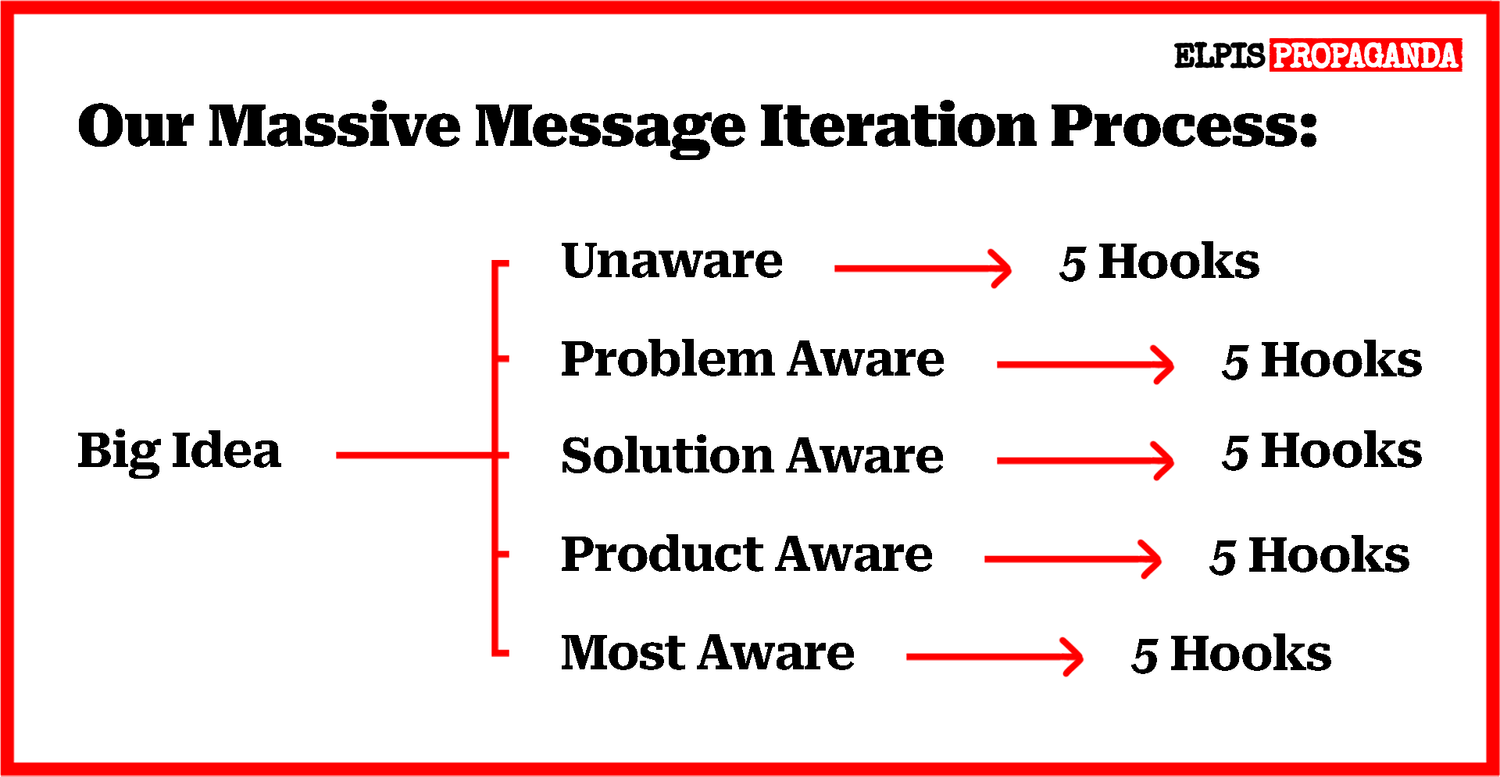
Let's do a case study on titanium cutting boards.
-
First, you find a Big Idea.
This is your narrative direction.
For example:
“Wooden cutting boards can make your children sick and even kill them. The only solution is to use titanium cutting boards — and the best ones are on my website.”
You could use another health-related Big Idea, saying it’s even more dangerous for elderly people…
…or say that plastic boards put microplastics into your body, affect fertility, increase the risk of birth defects, or promote cancer.
…or use eco-focused Big Ideas, saying they are not recyclable or that they contribute to deforestation, for example.
It’s extremely important to iterate massively on specific Big Ideas, because someone can be deeply affected by the idea of losing their child — but if they don’t have children, why should they care?
You are not only selling to a 45–55-year-old woman with children… you can also target patriotic men by saying it’s made in the USA.
Your market is much broader than you think.
You can reach almost anyone in the world who could potentially use a cutting board by iterating massively on Big Ideas, because this allows you to be extremely specific.
And of course, for each Big Idea, we create a new adapted Landing Page on which we perform an A/B test of the Headline.
-
Then, you adapt your Big Idea to the 5 Awareness Stages.
Even if the idea seems like everyone is already solution-aware, you still need to build a funnel for every prospect in your market, to maximize your chances of reaching everyone at the right stage — and to guide them through the awareness journey.
If you can do it, you have to do it.
We’re no longer in the era of paper ads.
Today, you can reach even a small audience of 10,000 people worldwide with a very small budget — and still be extremely profitable.
And again, you never know what will work best.
You want to be able to test everything concretely.
Believe me, 97% of bestsellers are big surprises.
-
The last element is Hooks.
For the same Big Idea and the same awareness stage, you can hook people through fear, anger, soft concern… whatever fits.
Again, it’s impossible to know which one will perform best.
It may even depend on the season, the day of the week, or the hour when they read your message.
Hooks can use different emotions, or the same emotion expressed with different words.
For example, with the Big Idea “sick children,” you could have different approaches:
Fear:
“Your child could get seriously ill without you even realizing it.”
Anger:
“No one told you this simple kitchen item could harm your child.”
Soft concern:
“Not sure your child is truly safe? Here’s how to protect them.”
It’s all about small details creating massive differences.
But because it’s absolutely impossible to know which hook will be the best — the best words, the best phrasing — you iterate again.
–
Big Ideas, Awareness, Hooks…
The only way to find the ultimate bestseller is to iterate again and again.
That’s exactly what this system is built for.
To find the best Big Idea, with the best hook, for the best awareness audience.
When you test 25, 50, 100, or 200 messages per week, it completely changes the game.
It’s no longer about luck, you just compress the time that stands between you and your success.
That’s our thesis:
Your capacity to achieve massive success is proportional to your capacity to massively iterate.
What about us now?
We can go from 25 messages per month to 900, or even up to 2,700.
It depends on your ambition.
And it also depends on distribution — you can learn more about that here. <<
In any case:
We audit, see what's best and what's possible for you, your product, your brand… and together we take the smartest decision.
Founder Message:

We can work with any project — as long as our vision aligns.
Whether you're a funded startup, a solo founder, an e-commerce brand, a personal brand, a newsletter creator, or a mostly offline business — we tailor the system to your goals, your budget, and your audience.
What I want is to work on big projects with ambitious, smart people.
I personally reply to every message, reviewing what you do and what we could do together, always looking for long-term mutual interest.
>> Learn more about my experience, our principles and our vision.
Founder Message:
We can work with any project — as long as our vision aligns.
Whether you're a funded startup, a solo founder, an e-commerce brand, a personal brand, a newsletter creator, or a mostly offline business — we tailor the system to your goals, your budget, and your audience.
What I want is to work on big projects with ambitious, smart people.
I personally reply to every message, reviewing what you do and what we could do together, always looking for long-term mutual interest.
>> Learn more about my experience, our principles and our vision.
Apply now.
Name:
Job title:
E-mail:
Company name & Website:
P.S: You may have noticed that I did the same work here:
I made you aware of a problem — most companies only do marketing.
You probably do too…
…And this creates a massive opportunity cost.
It doesn’t just limit your growth, it actually makes you lose money.
Now, you can apply to start playing the Propaganda game with us — we're the best positioned to help you do it.
Copyright © 2026 by Elpis Propaganda LLC — NOT FOR DISTRIBUTION
contact: sophianike.xyz@gmail.com
Create Your Free Account