
Founder, Principles, Vision.
My story.
I’m Nicolas Guthauser, born in Paris in 2001.
I dropped out of school at 15 to start my own business.
I worked for Agora, the world’s #1 Direct Response Marketing company ($2B/year), selling financial advice.
My job was to write long-form VSLs (8,000 to 15,000 words) to sell newsletters priced anywhere from $100/year to $5,000/year, using high-pressure marketing.
That’s where I learned copywriting in its most technical form.
Here, I was mentored by Annabelle Forde, the niece of Mark Ford — author of Great Leads (arguably the greatest copywriting book ever written) and co-founder of Agora.
There, I worked more on conversion than monetization, and that’s clearly where I learned propaganda:
How to create beliefs in people, highlight problems they didn’t even know they had, and guide them through a narrative toward a solution.
The job was to speak to unaware audiences — to tell fat-tail stories, build big narratives around Big Ideas, make people realize they had a problem, and then sell them the solution.
They were living a comfortable life, but you had to convince them that a major crisis was brewing — in the financial system, in politics, or elsewhere.
That markets were about to collapse, that they needed to protect themselves and their money — and then sell them a newsletter containing “information the mainstream media won’t talk about.” and financial advices.
I also wrote for an advisor to the Pentagon and the CIA, and for a French presidential candidate — figures whose name I must keep confidential now.
I quickly wanted to start my own business, because I had very little decision-making power inside such a large machine.
So I left…
And that’s when I met my next mentor.
-
He is a 9-figure esoteric copywriter who had made his fortune in clairvoyance.
And there, I was trained to sell the kind of products that make you think: “Are people really buying this?”
Looking back, it’s almost funny — I realize I spent years playing business on hard mode: selling quantum audio tracks and other spiritual infoproducts.
Everything was in the story.
It was pure funnel business: long VSLs, tons of ads while saying just enough to avoid getting banned, optimizing LTV with subscription bumps…
Everything that smells like shit — you do it.
To be honest, it was almost a scam.
Not exactly — people did receive what they paid for: essentially nothing... and we had an extremely lax refund policy to remain “morally acceptable”.
Overall, the front-end value was mediocre, even if many customers gave positive feedback — which, in reality, was mostly due to the post-sale listening and support.
After that, when you work on products that actually provide real benefits, everything changes.
Today, I apply the same Direct Response Copywriting Standards — but I produce these messages in a systematic and massive way, for products and people that I find interesting.
Our Principles.
These principles are here to clarify why we do what we do, how we think, how we work, and how we make decisions.
They’re inspired by the structured approach of Principles by Ray Dalio and The Almanack of Naval Ravikant.
By reading this, you’ll understand what we value, how we act, and what it’s like to work with us — whether you’re a client, a partner, or just passing through.
They define not only what we do, but also what we don’t do — so no one builds false expectations.
1 - Lean Culture.
This is the foundational principle behind everything we do.
We don’t believe in ideas — not even the good ones.
I personally think I have very good intuitions... and often, we do.
But we don’t trust them unless the market validates them.
The only thing that matters is how people react, how prospects respond, how the market answers. That’s our single source of truth.
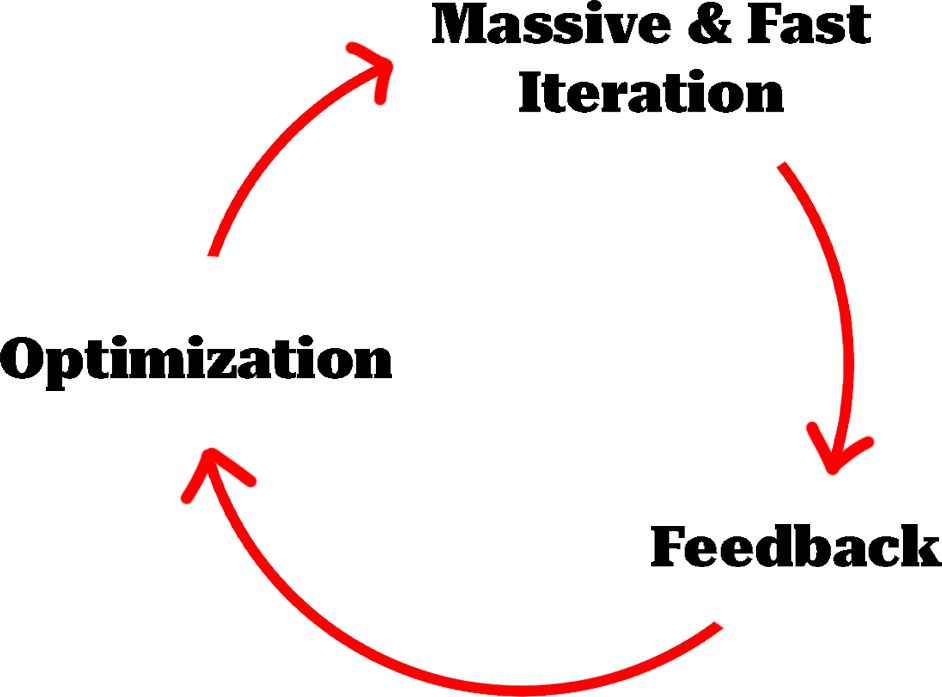
The more we iterate, the more feedback we get, the more we can optimize… and the better we get — for ourselves, for our clients, for your clients.
Everything we’ve built comes from that:
My own journey as a founder is the result of massive personal iteration — working with different types of clients, testing different offers, breaking things, learning what works.
The Propaganda Systems we use today were born from the constant iteration of previous systems that didn’t.
Even our way of working — the people I’ve worked with, the good and the bad experiences, the projects that moved fast, the ones that failed… All of this has shaped the principles, the culture from which we work today, and the people we choose as collaborators, clients, and partners.
It’s the same when we work with you.
Your market has all the answers, so we iterate massively until we find your Product-Market Fit – Message-Market Fit – Distribution-Market Fit.
And we do it as fast as possible — because speed of iteration means speed of learning.
The goal is to compress time.
If you test one message per month, even with multiple angles and hooks, you move 30 times more slowly than if you test one message per day.
Information doesn't add up, it multiplies together, so the compound effect when you multiply by 30 per month is massive over 1 year, 5 years...
This obsession with time compression runs deep in how I work.
It’s part of who I am. That’s why I dropped out of school at 15.
I struggle mentally when things move slowly and when I know they could move faster.
It's not about rushing things, but about structuring the work differently to get it done as quickly as possible.
That’s the entire point of our system, and it’s exactly why it exists.
2 - Long-Term
As I said earlier: I struggle mentally when things move slowly.
And that’s probably why, originally, I struggled to think long-term.
I used to believe that what really mattered was what I could get done tomorrow — not in ten years.
And in a way, it’s true.
What you do today creates the consequences you’ll feel next month, next year, five years from now.
But what creates real value — the kind that lasts — is the ability to anchor yourself in time.
Naval Ravikant talked about this better than I ever could.

“In a longterm game, it’s positive sum. We’re all baking the pie together. We’re trying to make it as big as possible. And in a short term game, we’re cutting up the pie.”
I’ve always known that life is shaped over the long term — but it's hard to fully realize it, and even harder to apply it.
For years I tried to scrape a piece of the pie, now I want to make it bigger.
Long-term thinking hasn’t been part of my life for 50 years — it’s something recent.
And lately, I’ve been trying to make it real:
To take concrete actions that reflect it, and to bring more and more awareness to it.
I quit smoking, I started training again, I take better care of my health… I’m building long-term habits, long-term systems.
And Elpis Propaganda is the same.
It’s the part of my life I want to carry for 10 years.
It’s the first business I’ve built where I think:
“Who do I want to work with today — that I’ll still be working with in 2035?”
And I even hope to be able to see even further as I grow up more and more.
This principle isn’t just about companies or capital.
It’s about relationships.
I think long-term success comes from long-term people.
Why build a business that won’t exist in six months?
Why work with companies that will be dead in a year?
Why take short-term money if it kills long-term potential?
Still, if we're being honest, with AI, we’re all more or less fucked in the next few years.
But I’ve also told myself the same thing before — that the job would die for other reasons, etc.
And the truth is, life just goes on.
So yeah, maybe the company will be dead in a year.
But that’s not really the point.
The company can be dead in a year — but we can’t build it as if it will be.
We have to stay optimistic.
We have to build as if we’re building something for the next ten years —
Because that’s the only way we might actually build something that lasts ten years.
Otherwise, what’s the point?
We go home, sleep, and say the game’s over. We end it now.
We have to keep believing.
Even if we might all be dead in three years.
And that's a very important point when I choose the people and projects we work with.
There’s another part of long-term thinking I haven’t mentioned yet — the personal one.
In the long run, what I want isn’t just to build a company.
I want to become a VC.
Not tomorrow — but when I’m 40 or 45.
That’s the life I want for myself: waking up every morning with 30, 40, 50 files on my desk, filled with founders who are smarter than me, more technical than me, more operational than me — people building things that actually push the world forward.
I’ve always loved that world — the world of ideas.
If I’m honest, I’ve always been a better thinker than an operator.
I can operate, but it’s not where I’m at my best.
Where I’m at my best is here: understanding systems, understanding people, seeing patterns, finding leverage, and helping others use them.
And that’s what I want later:
Passing call, helping where I can, using my network when it matters...
...bringing the right people into the room, giving energy to those who need it.
And providing ideas to those who can execute better than I ever could.
To use capital as a lever for vision — not just my vision, but theirs.
To create capital so I can give it to people who will build extraordinary things with it.
To help young founders who are getting started.
To help older founders who have less energy but have the wisdom of past life.
To place bets on ambition, intelligence, obsession.
To watch people do things I could never do myself — and be part of it without being the one executing.
That’s the long-term game I want to play... and that’s why Elpis Propaganda exists in the first place.
Elpis Propaganda is how I generate the capital, the knowledge, the leverage, and the compound relationships that make this long-term path possible.
This is the game I’m playing.
And I want people to understand it clearly:
The company I’m building today is the foundation for the capital I’ll deploy tomorrow — into founders who are better operators than I’ll ever be.
This is the long-term vision.
This is why I’m here.
I used to ask myself:
“How do I make $10,000 this month?”
Now I’m asking:
“What can I do today to achieve the best possible result in 10 years?”
And how to build relationships with people who share the same mindset — even if we don’t have a mutual interest to work together right now.
That’s why transparency is so important.
3 - Transparency
On a personal level, transparency has always come naturally to me — unlike long-term thinking, which I had to learn.
Even if it creates friction sometimes, I’ve always told the truth.
With employers, when I was bored or fully engaged.
With business partners, when things were working — or clearly not.
With affiliates or collaborators, I always gave them every piece of information I had.
Because I believe that if I give you all the facts, you can make the best decision for yourself.
And if you do the same, I can make the best decision for myself.
And that’s how we find the real mutual interest between us.
Hiding information might reduce tension short term, but I think transparency is the best way to build trust in the long term.
And in business — just like in life — I believe it’s the only way to make things work for real.
It means being transparent about your strengths — but just as much about your weaknesses.
Being able to say:
“This is useful, this isn’t…
We don’t know how to do this yet.
Maybe we can build it together.
This doesn’t make sense to build.
We might be able to do it — but maybe it’s better if we find someone else together.
Maybe we need help.
You should not work with us on this job…
This isn’t working. We should stop.”
It also protects people from false expectations.
Because we don’t hide performance, we don’t overpromise.
Of course, it doesn’t only bring upside — but I deeply believe it’s what creates the strongest compound effect over the long term.
Vision.
Right now, we don’t own all our means of production — not yet.
We already have internal processes in place to create messages massively.
both on the theoretical level:
We know what to say, how to say it, and how to write it with the $2B Direct Response Copywriting Standards.and on the technical level:
We've built the daily production systems to create and publish all these messages.
We also handle organic distribution in-house: we manage the editorial rhythm and publish across social media accounts ourselves.
On the creative side, we have the in-house capacity to produce basic images and videos.
But:
We don’t yet have a dedicated high-level creative team for advanced production.
Important:
We’re actually dedicating ressources to research, particularly for creating face-cam video format by using avatars of real people's faces and voices to generate unlimited content without requiring filming time.
Our goal is to be able to create an infinite number of short videos per day across dozens, even hundreds of different accounts, featuring your face and your ideas...
We believe this will be the ultimate ‘Controlled Clipping’ tool for personal brands, also usable in media buying of course.
If you are interested in this game and have mastered it, please contact us.
We also don’t have a full media buying team working internally.
But in the long run, the goal is clear:
Build everything in-house.
The vision is to build a propaganda machine.
That machine will not just serve companies, it will own a piece of them.
And as it accumulates ownership, it also accumulates data, processes, people, and insight — all shared across projects.
Because when one system owns a piece of multiple companies, it can see patterns, transfer knowledge, reuse what works — and improve faster than anyone working in isolation.
We wanna play the Capitalism Game.
Apply now.
Name:
Job title:
E-mail:
Company name & Website:
Copyright © 2026 by Elpis Propaganda LLC — NOT FOR DISTRIBUTION
contact: sophianike.xyz@gmail.com
Create Your Free Account